


The belt should be worn keeping the chest straight and rested against the seat back.
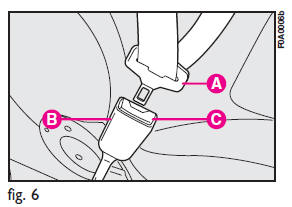
Take hold of the tongue A-fig. 6. Insert it into the buckle B, until you hear it clicks.
At removal, if it jams, let it rewind for a short stretch, then pull it out again without jerking.
 Never press button C when
traveling.
Never press button C when
traveling.
To unfasten the seat belts, press button C. Guide the seat belt with your hand while it is rewinding, to prevent it from twisting.
Through the reel, the belt automatically adapts to the body of the passenger wearing it, allowing freedom of movement.
When the vehicle is parked on a steep slope the reel mechanism may block; this is normal. The reel mechanism prevents the webbing coming out when it is jerked or if the vehicle brakes sharply, as in a collision or when cornering at high speed.
Every rear seat (where provided) is fitted with inertial seat belts with three anchor points and reel.
IMPORTANT
Before fastening the seat belts make sure the seat is properly anchored.
7-seat versions
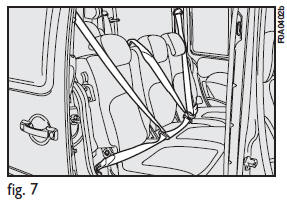
In the 7-seat versions, every rear seat (second and third row) is fitted with seat belts with three anchor points and reel fig. 7.
Remember that in the case of a violent collision, back seat passengers not
wearing seat belts also represent a serious danger to the passengers in the front
seats.
See also:
Seat Height Adjustment
The driver’s seat height can be raised or lowered by using a lever, located on
the outboard side of the seat.
Pump the lever upward to raise the seat height, or pump the lever downward to
lower t ...
Water in diesel fuel filter
The warning light on the dial turns on (on certain versions a message is displayed
on the reconfigurable multifunction display) when there is water in the diesel fuel
filter.
Turning the igni ...
Parking
Proceed as follows:
❒ Stop the engine and engage the handbrake;
❒ Engage a gear (first if the car is faced uphill or reverse if it is faced downhill)
and leave the wheels steered.
B ...