


1. Park the vehicle on a firm level surface, avoiding ice or slippery areas.
 WARNING!
Do not attempt to change a tire on the side of the vehicle close to moving traffic, pull far enough off the road to avoid the danger of being hit when operating the jack or changing the wheel.
2. Turn on the Hazard Warning flashers.
3. Set the parking brake.
4. Place the shift lever in PARK (automatic transmission) or REVERSE (manual transmission).
5. Turn Off the ignition.
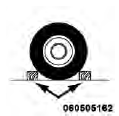
6. Block both the front and rear of the wheel diagonally opposite the jacking position.
For example, if changing the right front tire, block the left rear wheel.
 NOTE: Passengers should not remain in the vehicle while the vehicle is being
jacked.
NOTE: Passengers should not remain in the vehicle while the vehicle is being
jacked.
See also:
Daytime Running Lights — If Equipped
To activate the Daytime Running Lights (DRL), rotate the end of the multifunction
lever to the O symbol.
NOTE: The low beams and side/taillights will not be on with DRL.
The DRL function can be t ...
Cellular phone set-up
The system set-up, combined with radio consists of:
❒ dual-purpose aerial (sound system + cellular phone 900/1800 MHz), on the car
roof;
❒ dual-purpose connection wires and ten-pin c ...
Radio transmitters and cellular telephones
Radio transceiver equipment (e.g.: e-tacs mobile phones, HAM radio systems and
the like) shall not be used inside the vehicle unless a separate aerial is mounted
on the roof.
IMPORTANT The use of ...