


Front seats
According to the version, the head restraints can be:
– fixed fig. 61;
– adjustable in height fig. 61a.
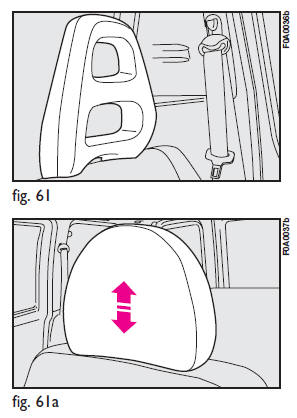
To adjust, move the head restraint upwards or downwards until it clicks.
Make sure it is properly locked in place.
Fixed head restraints cannot be removed.
Rear seats, 5-seat versions
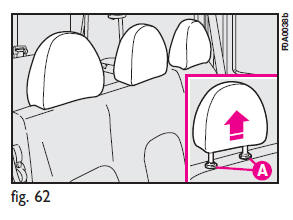
The height of the rear head (where provided) restraints can be adjusted fig. 62.
To remove the rear head restraints, remove the rear window shelf (see “Boot” in this chapter), press buttons A-fig. 62 by the side of the stands and pull the head restraint upwards.
 Remember that the head restraints should be adjusted to support the back of
your head and not your neck. Only if they are in this position will they be able
to provide effective protection.
Remember that the head restraints should be adjusted to support the back of
your head and not your neck. Only if they are in this position will they be able
to provide effective protection.
Rear seats, 7-seat versions
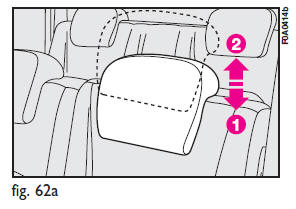
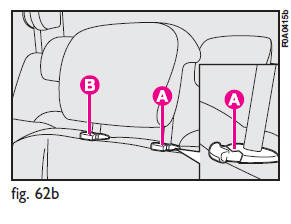
Head restraints for rear seats are mobile fig. 62a. To use head restraints, raise them from non-use position (1) to use position (2). To set them back to “non-use position” (1), press the outer button A-fig. 62b and push down the head restraint. Rear head restraints can be removed; to remove them: press buttons A and B and then raise them to complete removal.
Only make adjustments when the vehicle is stationary.
The particular head restraint shape voluntarily interferes with the passenger’s back leaning on the rear seat in order to force him/her to lift the head restraint and use it correctly.
IMPORTANT
Rear passengers shall always set head restraints to position (2) when traveling.
See also:
(B) Setting Up To Use TIREFIT
1. Turn the Mode Select Knob (5) to the Sealant Mode position.
2. Uncoil the Sealant Hose (6) and then remove the cap from the fitting at the
end of the hose.
3. Place the TIREFIT kit flat on the ...
Scheduled servicing
Correct maintenance is essential for ensuring long car life under the best conditions.
This is why Fiat has programmed a series of checks and maintenance operations
every 20,000 km. It is however i ...
Cooling System
WARNING!
• When working near the radiator cooling fan, disconnect the fan motor lead
or turn the ignition switch to the OFF position. The fan is temperature controlled
and can start at any time ...